THINKING REQUIRED · PART 01 OF 05
Reading, writing, arithmetic, AI.
In one experiment, AI doubles learning gains. In another, it worsens exam results. The difference lies in the teaching design, and that is the teachers' job. In 2029, PISA will measure for the first time how well young people deal with media and AI. What schools need to build by then.
 Prof. Dr. Dr. Josh Walter· 10 min read
KEY TAKEAWAYS
In February 2024, I published the paper “Embracing the future of Artificial Intelligence in the classroom” (Walter, 2024). According to Google Scholar, it has since been cited around 2,500 times, and it has been accessed more than a quarter of a million times. For a scientific publication, these are exceptionally high numbers. The paper hit like a bombshell because it takes on a hot-button issue: how do we use AI without giving up our own thinking? Recent studies show just how relevant this question remains today.
My answer: it takes three skills that only work together. The first is AI literacy: a basic understanding of how these systems work, what they do well and where they fail. The second is prompt engineering, the ability to give an AI precise instructions. The third is critical thinking. Our new series “Thinking Required” builds on this foundation. Over five articles, we explore this for schools, for personal practice and for professional life. We start with schools, and with two experiments that could hardly be more different.
For six weeks, first-year senior secondary students in Nigeria practiced English with the support of Microsoft Copilot. A World Bank study compared them with a randomly assigned control group. On the final test, which covered AI knowledge and digital skills as well as English, the participants scored 0.31 standard deviations higher, and 0.23 in English alone. In education research, the standard deviation is a common measure of the size of an effect. According to the researchers, this learning gain corresponds to 1.5 to 2 years of regular schooling, and the program is among the most cost-effective ones studied so far. Girls and students who were already performing well at the start benefited most (De Simone et al., 2025).
In Turkey, things went the other way. Nearly a thousand high school students practiced math with a standard version of GPT. As long as they were allowed to use the AI, they solved the problems much better. In the exam without AI, however, they scored 17 percent lower than students who never had access to the AI. A tutor version that gave hints instead of finished solutions largely prevented this effect (Bastani et al., 2025).
Same technology, opposite effect. This brings us to the central question of this first part: what do schools need to build so that AI strengthens learning instead of replacing it?
The difference is in the teaching.
Some of the most impressive evidence of the potential so far comes from an experiment at Harvard University. Physics instructors developed an AI tutor based on the same teaching principles they use in their in-class lessons, in which students actively work on problems. The tutor guided students through each part of a problem in a fixed order. It relied on solutions the instructors had worked out in advance instead of inventing its own, and it answered questions with individual feedback. In a randomized study with 194 students, learning gains with the tutor were more than twice as large as in class. Students needed a median of 49 minutes for this, compared with about 60 in class. They also felt more engaged and more motivated (Kestin et al., 2025).
The authors also describe what did not work. A system prompt alone, that is, a fixed basic instruction to the AI, was not enough to keep multi-part problems reliably in order. The structure had to be built into the learning platform itself. This shows that prompt engineering is also a teaching tool: how you instruct an AI is not a technical side issue but part of designing the lesson. It determines whether an AI delivers finished solutions or prompts thinking.
Education research knows several forms of so-called scaffolding, that is, targeted learning support by teachers: hints and specific questions, guided reflection, praise and feedback, alternative approaches, clear instruction, and modeling typical mistakes. Each of them can be built into an AI learning companion. But this only works well when it is done by people who know how to teach.
AI literacy becomes a basic skill.
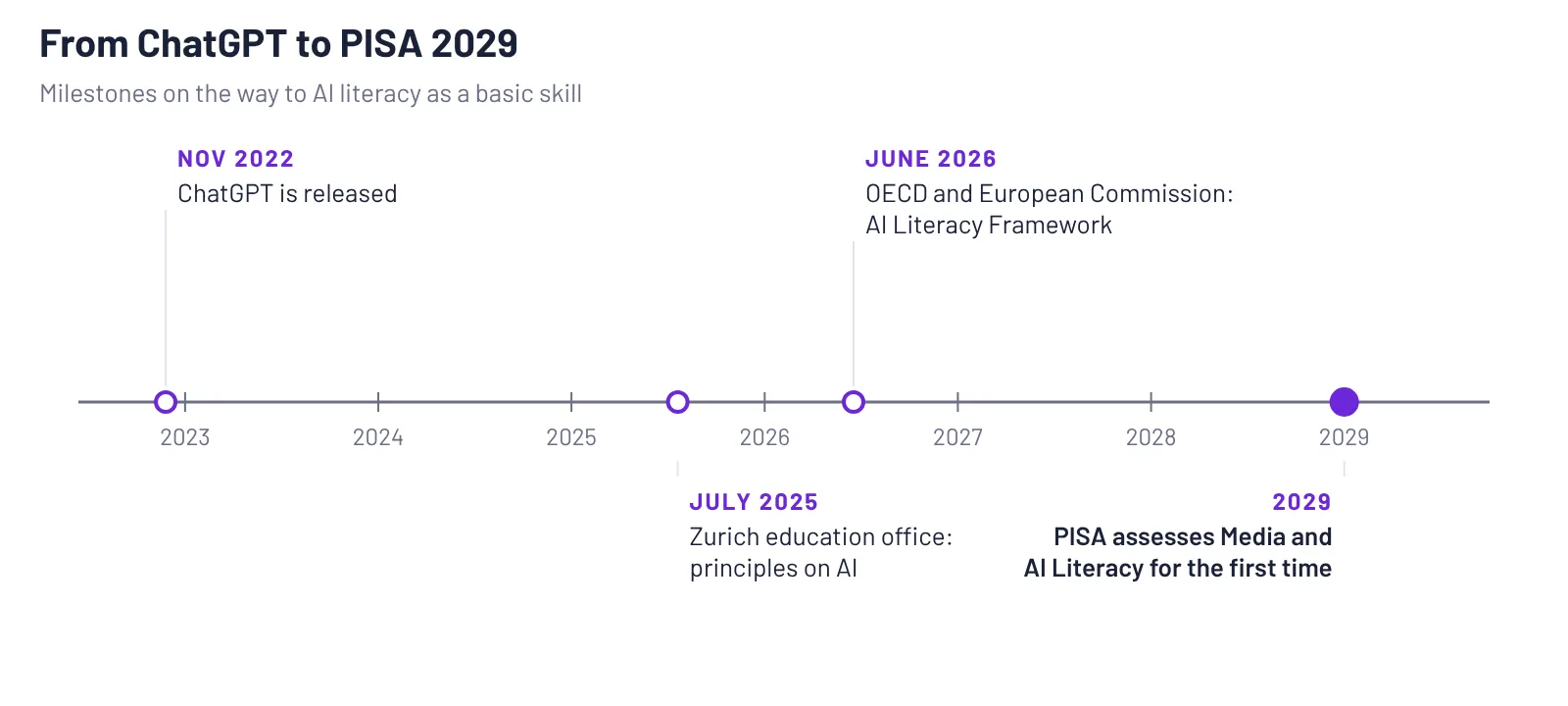
Understanding AI is becoming as fundamental as reading, writing and arithmetic. What sounded like a bold claim only a few years ago is now education policy. On June 18, 2026, the OECD and the European Commission presented the final AI Literacy Framework for primary and secondary education. It organizes AI literacy into four domains: Engage with AI, Create with AI, Manage AI and Shape AI. They cover engaging with AI consciously and critically, creating with AI, deciding responsibly about its use, and understanding how human values shape AI systems. The framework is deliberately not designed as a new school subject but is meant to be woven into existing subjects. Two of its statements could come from any staff room: AI systems are not human and cannot replace human judgment, care or relationships. And refusal or limitation can be a responsible and informed choice (OECD & European Commission, 2026).
In 2029, it becomes measurable. PISA, in which more than 90 countries and economies take part, will then assess Media and AI Literacy for the first time, that is, how well young people deal with digital content, including false and misleading content. According to the Australian Council for Educational Research (ACER), which develops and delivers PISA 2029 on behalf of the OECD, it is the first study of its kind to assess how equipped the next generation is to co-exist with AI (ACER, 2026).
Switzerland shows how great the need is. According to the JAMESfocus report by ZHAW and Swisscom, 71 percent of 12 to 19 year olds use AI tools, rising to 84 percent among 18 and 19 year olds. AI tools are widely used in young people's everyday lives, says co-author Jael Bernath, but a nuanced understanding of the risks and opportunities of AI is often missing. According to her, the same applies to adults (ZHAW, 2025).
Teachers are the bottleneck.
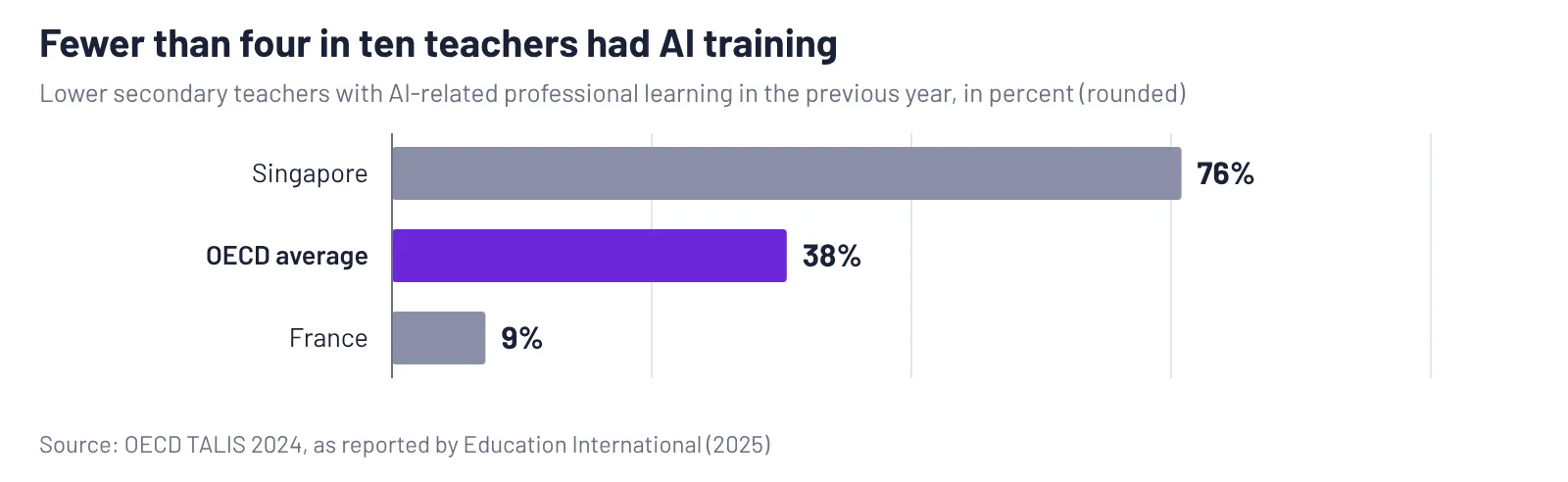
The latest edition of the OECD's international teacher survey TALIS also asked how teachers use AI. On average across OECD countries, about 41 percent of lower secondary teachers use AI in their teaching, most often to learn about a topic or plan lessons. Of those who do not use AI, 75 percent cite a lack of knowledge and skills as the reason. Only 12 percent say their school prohibits it. On average, only about 38 percent had AI-related professional learning in the previous year (Education International, 2025; OECD, 2025).
The differences between countries are huge. In Singapore, almost 76 percent of teachers had AI training, compared with 9 percent in France. In Singapore, 75 percent of teachers use AI, in France 14 percent (Education International, 2025). So where more teachers are trained, more of them also use AI. Whether one causes the other, however, these figures do not show.
The investment also pays off for teachers themselves. A survey by Gallup and the Walton Family Foundation in the United States shows that teachers who use AI regularly save an average of 5.9 hours a week. Over a school year, that adds up to about six full weeks (Walton Family Foundation, 2025).
Universities know this too: when a university of applied sciences in Zurich introduced its first rules for using AI, a lack of knowledge was the biggest hurdle. Many lecturers were afraid of using AI incorrectly because they knew too little about it. There were no workshops, no budget and no position responsible for the topic. The TALIS figures show that this pattern is widespread around the world.
A six-step roadmap.
| Step | What it takes | Why |
|---|---|---|
| 1. Guidelines with declaration | Rules per assignment and a declaration that also states how AI output was checked, for students and teachers | Creates fairness and transparency (see part four) |
| 2. Training with a budget | Time and money for all teachers, not only the interested ones | 75 percent of non-users cite a lack of knowledge |
| 3. Clear responsibility | A person or team with paid hours | Without clear responsibility, everything depends on the private commitment of individuals |
| 4. AI literacy across subjects | Integrate building blocks into existing subjects rather than adding a new one | This is also what the AI Literacy Framework envisages |
| 5. Teaching with guardrails | AI learning companions that ask questions instead of giving solutions | Decides whether students learn more or less with AI |
| 6. Fair access and data protection | Approved tools, no personal data, equal opportunities for all | Prevents new inequalities |
None of these steps is new. What is new is that research now shows why they are needed.
What research does not know yet.
Being honest also means naming the open questions. Long-term studies on the effects of AI on learning, teachers and well-being are still missing because the technology is too new. The first randomized experiments exist, but they last weeks, not years. The Harvard tutor was tested in a single course, and the Nigerian program ran for six weeks. Whether the effects last remains open. Schools should therefore design their own pilot projects so that they can learn from them: with a clear question, a comparison group and an evaluation.
What this means in practice.
For school leaders and authorities
- Plan AI training as a fixed part of staff development, with a budget and working time.
- Appoint a responsible person or team to follow developments and support colleagues.
- Start with a few well-evaluated pilot projects instead of a school-wide rollout.
For teachers
- Try AI for your own preparation first. Those who know the tools also recognize their limits.
- Use study modes or your own instructions to the AI so that it asks students questions instead of giving them solutions.
- Make AI itself a topic in class: have students compare, check and critique AI answers.
SELF-CHECK: AI AT OUR SCHOOL
What comes next.
Part two is about you. Why do those who know AI best misjudge themselves the most? And how does AI turn from ghostwriter into sparring partner?
BUILD AI LITERACY AT YOUR SCHOOL
We support schools and universities from guidelines and teacher training to teaching design.
AI @ Schools: Support for teachers, school leaders and universities so that AI promotes learning instead of replacing it. More at the-aimi.com/ai-schools.
Webinars: Short live sessions to get started, such as “Understanding AI in 30 minutes.” All dates at the-aimi.com/webinar.
AI Academy: The AI Fluency & Management program for everyone who wants to use AI confidently and critically. More at the-aimi.com/en.
AI Trainings: Tailored training for teams and organizations. More at the-aimi.com/ai-trainings.
References (11)
- ACER. (2026, April 1). ACER to deliver PISA 2029 with novel focus on AI and media literacy. Australian Council for Educational Research. https://www.acer.org/news/article/acer-to-deliver-pisa-2029-with-novel-focus-on-ai-and-media-literacy
- Bastani, H., Bastani, O., Sungu, A., Ge, H., Kabakcı, Ö., & Mariman, R. (2025). Generative AI without guardrails can harm learning: Evidence from high school mathematics. Proceedings of the National Academy of Sciences, 122(26), e2422633122. https://doi.org/10.1073/pnas.2422633122
- De Simone, M., Tiberti, F., Barron Rodriguez, M., Manolio, F., Mosuro, W., & Dikoru, E. J. (2025). From chalkboards to chatbots: Evaluating the impact of generative AI on learning outcomes in Nigeria (Policy Research Working Paper 11125). World Bank. https://openknowledge.worldbank.org/entities/publication/15e1ff08-15ae-4f7a-b2a8-d146e6c113ee
- Education International. (2025, December 5). Using artificial intelligence: Takeaways from TALIS 2024. https://www.ei-ie.org/en/item/31815:using-artificial-intelligence-takeaways-from-talis-2024
- Kestin, G., Miller, K., Klales, A., Milbourne, T., & Ponti, G. (2025). AI tutoring outperforms in-class active learning: An RCT introducing a novel research-based design in an authentic educational setting. Scientific Reports, 15, 17458. https://doi.org/10.1038/s41598-025-97652-6
- OECD. (2025). Results from TALIS 2024: The state of teaching. OECD Publishing. https://www.oecd.org/en/publications/2025/10/results-from-talis-2024_28fbde1d.html
- OECD & European Commission. (2026). AI Literacy Framework for Primary and Secondary Education. https://ailiteracyframework.org/blog/empowering-learners-for-the-age-of-ai-literacy-framework/
- Volksschulamt Kanton Zürich. (2025, July 24). Künstliche Intelligenz in der Volksschule. https://www.zh.ch/de/bildung/informationen-fuer-schulen/informationen-volksschule/volksschule-schulinfo-unterricht/kuenstliche-intelligenz.html
- Walter, Y. (2024). Embracing the future of Artificial Intelligence in the classroom: The relevance of AI literacy, prompt engineering, and critical thinking in modern education. International Journal of Educational Technology in Higher Education, 21, 15. https://doi.org/10.1186/s41239-024-00448-3
- Walton Family Foundation. (2025, June 25). Six weeks a year: How AI gives teachers time back. https://www.waltonfamilyfoundation.org/learning/six-weeks-a-year-how-ai-gives-teachers-time-back
- ZHAW. (2025, May 15). Künstliche Intelligenz im Alltag von Jugendlichen [Press release on the JAMESfocus report 2025]. https://www.zhaw.ch/de/medien/medienmitteilungen/detailansicht-medienmitteilung/event-news/kuenstliche-intelligenz-im-alltag-von-jugendlichen